
Frequently Asked Questions
-
Through a Project Board and Finance Sub-Group. Chaired by London Borough of Richmond upon Thames as the accountable body. Representatives from each of the partners (Chairs of each partnership). A representative from the Thames RFCC and the Thames Estuary 2100 Department sit on the Board in an advisory capacity. The Finance Sub-Group is Chaired by the Thames RFCC representative.
-
Three established partnerships:
Thames Landscape Strategy Partnership: Comprises local authorities, key stakeholders (including Historic Royal Palaces, Communities Advisory Group). Memorandum of Understanding and governance structure in place. Has been operating for over 30 years.
Thames Strategy Kew to Chelsea Partnership: Comprises local authorities, key stakeholders including local community representatives.
Thames Estuary Partnership: Registered charity. Board of Trustees. Newly established local authority steering groups.
-
The Joint Thames Strategy programme is being funded through £1.741million of grant funding from the Thames Regional Flood and Coastal Committee (the Thames RFCC).
The Thames RFCC was established by the Environment Agency and brings together members appointed by Lead Local Flood Authorities and independent members with relevant experience for 3 purposes:
to ensure there are coherent plans for identifying, communicating and managing flood and coastal erosion risks across catchments and shorelines
to encourage efficient, targeted and risk-based investment in flood and coastal erosion risk management that represents value for money and benefits local communities
to provide a link between the Environment Agency, Lead Local Flood Authorities, other risk management authorities, and other relevant bodies to build understanding of flood and coastal erosion risks in its area’
Please check the Thames RFCC website for more information.
-
The Thames Strategy Partnership (TSP) is the collaboration between the Thames Landscape Strategy Partnership, Thames Estuary Partnership and Thames Strategy Kew to Chelsea Partnership sharing 30 years of expertise shaping the Thames' future. We are supported by the London Borough of Richmond upon Thames with advice from the TE2100 Team and the Thames Regional Flood and Coastal Committee to deliver the Joint Thames Strategy.
-
The area of coverage has taken account of the London Plan 2021’s Thames Policy Area boundaries. For those areas outside of the Greater London Area the characteristics that have been used to define the Thames Policy Area have been used.
The tributaries and their respective partnerships and managers will be one of the consultation stakeholders and will be involved in the development of the strategies where they are situated.
-
Whilst they are ‘non-statutory’ documents they can be a ‘material consideration’ in the planning process. For those local planning authorities within the Greater London Authority area the London Plan 2021 provides the strategic planning policy framework for the Thames Strategies. A large proportion of London Boroughs include reference to the Thames Strategies within their adopted and/or emerging Local Plans.
As well as being used through the planning system (local planning authorities/applicants/landowners) we see them as having multiple purposes including:
Providing a framework for securing funding to implement projects identified through the Strategies e.g. the ‘Rewilding Arcadia’ project in the Thames Landscape Strategy Area.
Informing local authority/public bodies investment strategies/priorities.
Informing decisions on how to create additional flood alleviation/capacity.
How to protect and celebrate existing built/industrial/natural heritage.
Identifying opportunities to improve accessibility to the River.
Informing approaches to designing public realm improvements.
Helping property owners to respond to managing/alleviating flood risk.
Helping local communities to understand and get involved in influencing the shaping of their local area.
One of the benefits of the approach that we are taking is that councils could potentially use the relevant Thames Strategy for their area rather than create their own Riverside Strategy. This has multiple benefits including that they would be able to get a Riverside Strategy in place quickly and would avoid them having to do work that has already been done. If a council decided to use the relevant Thames Strategy then ideally they should go through a formal decision-making process to make it clear that they are using it as the basis for their ‘Riverside Strategy.’
-
The strategies are following both Historic England and Natural England’s guidance for LCA’s and a framework for this programme was produced and agreed in the early stages of the process. The LCA process provides the technical framework for undertaking the LCA work, which is a core component of the refresh activities. The Checklist, which is being used for all of the Thames Strategies, makes sure that a consistent approach is taken across the project area, and also embeds the TE2100 Plan ‘Riverside Strategy Approach’ requirements.
-
We have established a Stakeholder Advisory Group which meets on a regular basis. The Group provides an opportunity to garner a strategic overview from the individual organisations’ perspectives, and to take a coordinated approach between the work being undertaken through this programme and relevant activities being undertaken by the stakeholders. The core membership is comprised of representatives from:
The TE2100 Team
Historic England
Natural England
Greater London Authority
Port of London Authority
-
‘We need to adapt to climate change along the Thames Estuary. As sea levels rise and defences get older, the risk of flooding from the Thames increases.’
‘The Thames Estuary 2100 Plan outlines how to manage this risk.’
Source: TE2100 introductory webpage
‘Managing flood risk as sea levels rise will mean reshaping our riversides. This is an opportunity to create additional benefits. We want to provide benefits to people, the economy and the environment. Some examples of benefits include:
better opportunities for leisure and recreation, such as riverside paths
improved health and wellbeing, for instance by creating more green space for people to enjoy
creating new wildlife habitat
natural carbon storage, for example by creating saltmarshes
protecting landscapes
protecting historic buildings, such as the Tower of London
Source: TE2100 website ‘Creating Benefits and riverside strategies’
3. Creating a better riverside for local communities
Visions for the riverside show how flood defence upgrades can deliver social value and multiple benefits. These also enable upgrades to take place through riverside development.
‘3.1 By 2030, councils, the Greater London Authority and the Port of London Authority will have worked with communities to co-develop visions for adapting riversides to sea level rise. These should incorporate the minimum requirements of the riverside strategy approach, deliver social, environmental and economic benefits, and promote continuation of the Thames Path.
3.2 By 2030, the Joint Thames Strategies (Thames Landscape Strategy, Thames Strategy – Kew to Chelsea, and Thames Strategy East) will have been updated to reflect the riverside strategy approach and extended to cover all reaches of the Thames Estuary. [Our emphasis]
3.3 By 2030, local planning authorities will have embedded these visions into the statutory spatial planning framework. This will increase opportunities to realise multiple benefits through upgrading defences as part of riverside development.’
Source: ‘What needs to be done’ TE2100 webpage
The project is recognised by the Environment Agency as a mechanism for delivering riverside strategies.
-
There are currently two – the City of London Riverside Strategy and the Lower Darent Riverside Strategy (Dartford Borough Council, Kent). The approach that the Thames Strategies are following is at a much larger scale and are more complex. Nevertheless it is always helpful to visualise what a Riverside Strategy can look like.
The River Darent is a tributary of the River Thames. The Strategy was the winner of The Royal Town Planning Institute’s (RTPI) National Planning Awards 2025 category for ‘Excellence in Planning for the Natural Environment’ and the RTPI’s Silver Jubilee Cup. The awards celebrate outstanding projects that improve the natural environment through conservation, restoration or enhancement as the Silver Jubilee Cup is one of the most prestigious awards in Town Planning. The judges’ summary provides a succinct way of articulating the benefits of adopting the Riverside Strategy approach.
‘The Lower Darent Riverside Strategy stands out for its comprehensive, evidence-based approach to sustainable flood defence. Judges applauded its innovative use of nature-based solutions, strong policy links, and adaptive, community-focused engagement. This project sets a benchmark for resilience, inclusivity, and regeneration, offering valuable lessons for others.’
‘The project stands out for embedding flood alleviation at the heart of its design and delivery. It offers valuable lessons on a challenge that is being faced by many communities, demonstrating a collaborative and forward-thinking approach that fosters innovation and shared learning. By adopting an ecosystems-focused framework, the strategy delivers sustainable, resilient, and lasting benefits for both people and the natural environment.’
The Bio reads:
‘The Lower Darent Riverside Strategy innovatively addresses flood risks and climate adaptation, enhancing community resilience, biodiversity, and sustainable development through Nature-based Solutions and holistic design.’
-
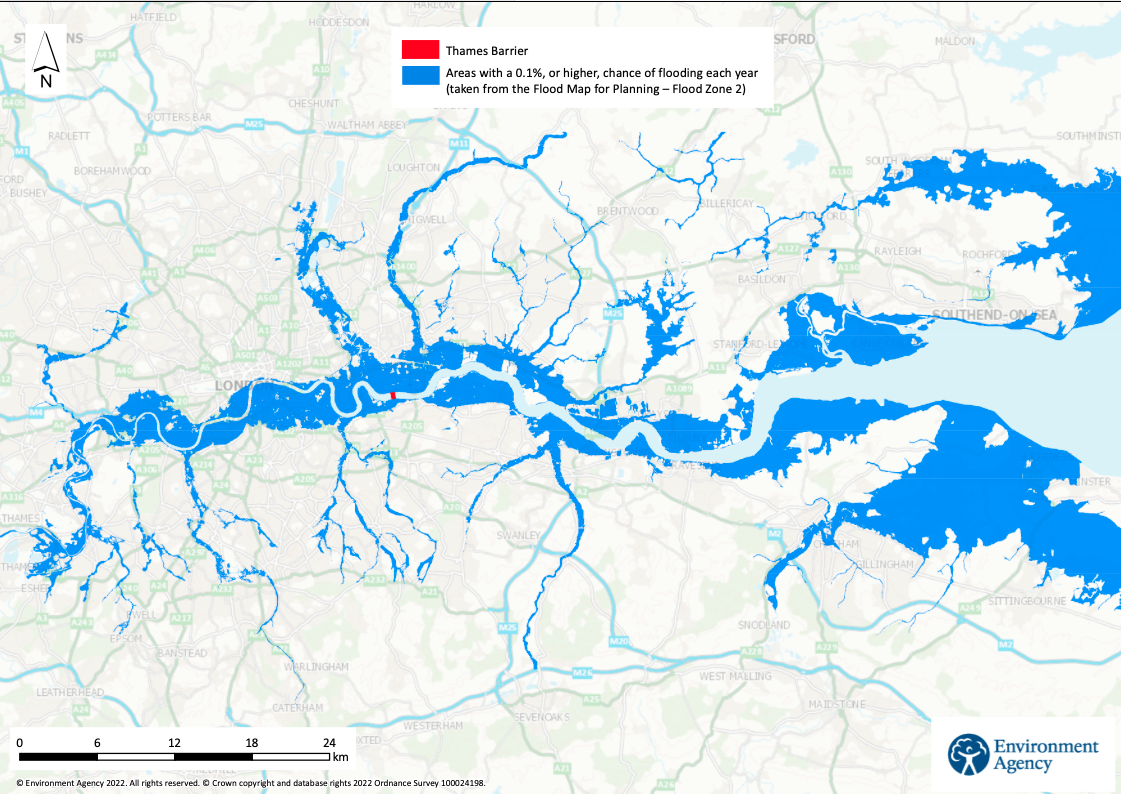
The geographic areas that the project covers include:
residential properties
business premises
cultural, heritage and natural assets
critical infrastructure including road and rail
schools and hospitals
public spaces important to local communities
river related infrastructure e.g. slipways, piers, wharfs